
Grant County Projected Versus Actual Release
Three dates are often confused. ODOC uses “projected release date,” or PRD, for its estimated sentence-administration date. A parole eligibility date marks the point when law permits consideration for parole. It is not a parole decision. An actual release or discharge date records what already happened. A court sentence end, PRD, eligibility date, Board hearing, Board result, and physical exit can all be different.
The Oklahoma Pardon and Parole Board glossary says ODOC calculates a PRD for each offender and that credits, programs, and misconduct can move it. PPB does not calculate the date. ODOC also states that an inmate's precise future release date is confidential to ordinary public inquirers absent a legitimate need and remains tentative. Public tools can confirm identity and status, but they should not be presented as an open exact-date calendar.
A Grant County pretrial detainee has no calculated ODOC PRD. Bond may be set, denied, changed, or posted, and a judge may enter an order, but another case or hold can delay release. The Grant County Sheriff record shows when custody actually changed and where the person went. A sentenced county inmate also requires the judgment, jail credit, and local discharge record rather than an automatic application of ODOC's prison credit table.
Find Grant County Projected Release Dates
Choose the route by custody type. The ODOC Offender Lookup covers people who entered state custody or supervision. Someone who served local time or bonded out of Grant County Jail may never appear there. A person who vanished from the local jail after sentencing may appear later because ODOC received the person. That event is a transfer, not release to the community.
- Confirm the person and custody system. Call Grant County Jail for local custody, or search ODOC by number, exact name, and date of birth for a state record.
- Open the Grant County court case. Read the judgment, sentence length, concurrent or consecutive terms, jail credit, later orders, and any bond or hold entries.
- For ODOC custody, compare stable identifiers and read status literally. Do not claim that the public result shows an exact PRD unless that field appears in the current matching record.
- For a county sentence, ask the Sheriff for the discharge record and ask the Court Clerk for the judgment and filed orders. ODOC class formulas do not automatically govern local confinement.
- For an authorized future state date, use the inmate's monthly days-remaining information or the ODOC channel permitted for that requester.
- For a past state release, request the Certificate of Release or sentence history. It can show exact release day, release category, cases, credits, and remaining supervision.
The full Grant County release record search explains how to follow a destination when the county record says ODOC, another jail, federal custody, or ICE. A no-result in the wrong system never proves community release.
Note: ODOC number is the strongest public search key when names, aliases, or dates of birth produce several possible matches.
Grant County Release Date Confidentiality
ODOC's public guidance draws a firm line: an exact future release date is confidential to general requesters without a legitimate need. The inmate receives a monthly days-remaining figure and may share it. ODOC warns that the figure is tentative because credit level, misconduct, and achievement credits can change it. Public search results cannot promise access the agency says is restricted.
Read ODOC's official offender-information explanation before relying on a date stated by another source.
The captured ODOC page illustrates why a tentative future date must be handled through the proper state channel, not copied as a firm promise.
A past date is different. ODOC Closed Records handles discharge inquiries at 405-425-2691 and osordischarges@doc.ok.gov, while the state open-record form can seek releasable sentence or status-change material. Sensitive incarceration or supervision files may require authorization, a subpoena, or a court order. For Grant County Jail, send a narrow written request to the Sheriff for the date, time, manner of discharge, and receiving authority if transferred.
Oklahoma Credits Shape Grant Release Dates
Title 57 § 138 governs earned credits, and ODOC policy OP-060211 implements sentence administration. Credit depends on statutory eligibility, class level, conduct, assignments, programs, sentence structure, and other rules. Credits can be lost for misconduct or nonperformance. Restoration can be considered when a person qualifies, but it is discretionary. This is why two sentences of the same stated length can have different projections.
ODOC's policy publishes administrative estimation factors for several credit levels. They range from Level 2 through enhanced Level 4 and can be prorated when class status changes during a month. Restricted-credit sentences follow different limits. Those factors are not a safe public calculator. A correct computation also needs the offense date, aggregated cases, concurrent or consecutive terms, jail credit, program credit, misconduct, holds, and later audit corrections.
Open ODOC's official projected-release worksheet to see the documented administrative framework.
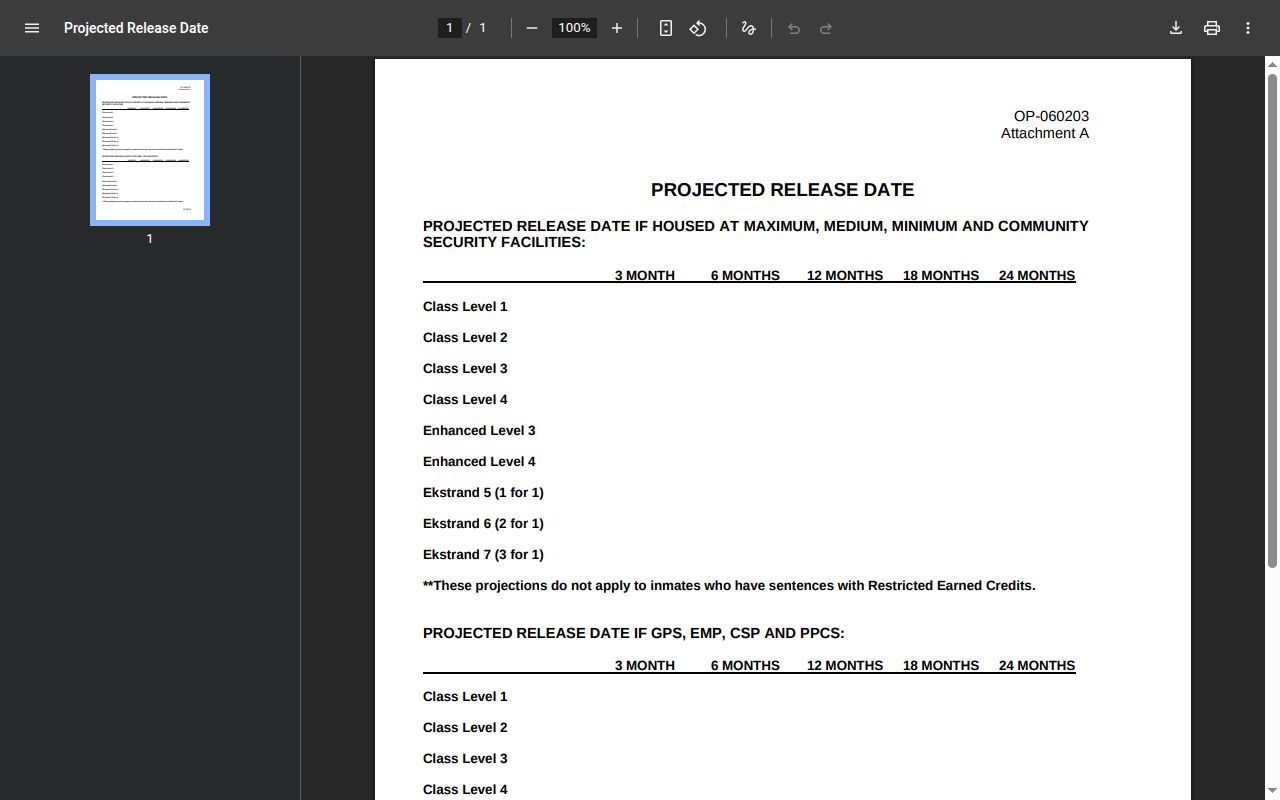
The worksheet shows why sentence staff need facts and records that a public self-service calculator would not possess.
Grant County Deferred Reception Credits
A Grant County defendant sentenced to ODOC may remain at the county jail while waiting for state reception. ODOC's FAQ describes this wait as lasting months in typical cases, with short sentences and return-to-court cases receiving priority. Physical location at Grant County Jail can therefore overlap with state sentence administration.
Under § 138(G) and OP-060211, qualifying time from sentencing through ODOC reception receives Class Level 2 treatment. The policy calculates deferred-reception credit with a stated factor, subject to exclusions such as qualifying jail misconduct or offense. The credit can affect the state projection before transport occurs. It does not make the later trip from Grant County Jail to ODOC a release to the community.
Reconcile three records when that sequence appears. The Grant County judgment establishes the sentence. The jail record shows local location and the eventual receiving authority. ODOC records show reception and sentence administration. Reading only one can confuse physical place, legal sentence credit, and release status.
Grant Release Dates and 85 Percent
Oklahoma's 21 O.S. § 13.1 is not a rule for every prisoner or every offense described in plain speech as violent. It lists specific offenses that require at least 85 percent of the imposed imprisonment before parole consideration and limits how credits affect that threshold. The current offense list and offense date must be checked.
Parole eligibility is still not a PRD. PPB materials explain that nonviolent eligibility can depend on offense date and may use a fraction such as one-quarter or one-third, while listed cases follow the statutory 85 percent rule. Some sentences, including life without parole, are not eligible. The parole investigator uses the court sentence and jail credit, and later orders, commutation, misconduct, or audit corrections can change the hearing timetable.
No personal release date should be calculated from a short statute summary. The state sentence record controls the terms, ODOC controls the PRD, PPB controls its hearing process, and the actual release record proves what happened.
Note: Eighty-five percent marks a statutory limit for listed offenses, not a universal Grant County release formula.
Changes to Grant Projected Release Dates
A projection is a snapshot of facts then in the sentence system. New conduct, credits, court action, or custody claims can move the date or change what happens on it. Some events alter the numerical estimate. Others leave the date intact but stop release to the community.
| Factor | Possible effect | Record to check |
|---|---|---|
| Credit level or earned program credit | May move the estimate under statutory and policy rules | ODOC monthly credit report and sentence record |
| Misconduct or nonperformance | May reduce or remove credit and delay the projection | ODOC credit and disciplinary record |
| Credit restoration | May adjust time if ODOC finds eligibility and grants relief | ODOC sentence-administration action |
| New or corrected court order | Can change terms, jail credit, or concurrent and consecutive structure | Filed judgment and ODOC audit |
| Detainer or hold | May cause transfer to another authority instead of community release | Release certificate and receiving-agency record |
| Parole action | Can create a conditional release path, but eligibility or a docket date alone does not | PPB result and ODOC release record |
A parole to a detainer is a key example. ODOC can release a person from its authority into the hands of another agency. The ODOC event is real, but the person is not free in the community. The Certificate of Release and destination field prevent that error.
Confirm Grant County Actual Release
For a local case, call Grant County Jail at 580-395-2356 and ask for current custody. If the person left, request the exact date, time, manner of discharge, and receiving authority. Pair that response with the court judgment or release order. A court entry can explain authority, but another hold or jail processing may separate the order from the physical exit.
For a state case, a past Certificate of Release is stronger than a roster disappearance or Board docket. It identifies the exact day and release category and can state whether supervision remains. For an upcoming custody event, the Grant County VINELink release check can provide a participating-agency alert, but VINE is notification rather than certification and may lag.
Use the result's agency and event language. “Released” from Grant County can mean transfer to ODOC, another county, federal authorities, or ICE. “Parole” means conditional community supervision rather than full discharge. “Not in BOP custody” answers only the federal system. Each conclusion must stop at the boundary of the record that produced it.