
Grant County VINELink Release Coverage
Grant County’s own Sheriff page promotes Oklahoma VINELink even though it offers no public jail roster. Oklahoma VINE is a confidential custody-status and alert service that can be searched anonymously by web, phone, or app. Its records and notices depend on the agency feed. The research did not establish a guaranteed real-time Grant County module, so the reporting agency and update time matter on every match.
VINE can report events such as release, transfer, escape, apprehension, or death when the participating agency supplies them. These words describe the event in that agency’s custody chain. “Release” from Grant County might mean return to the community, but it can also coincide with another authority taking custody. The Sheriff’s date, manner, and destination record resolves that boundary. State-prison events should be checked against ODOC information.
The Oklahoma Attorney General’s VINE material describes search and notification choices. The assigned capture shows the official state guidance that supports the Grant County release-check route.
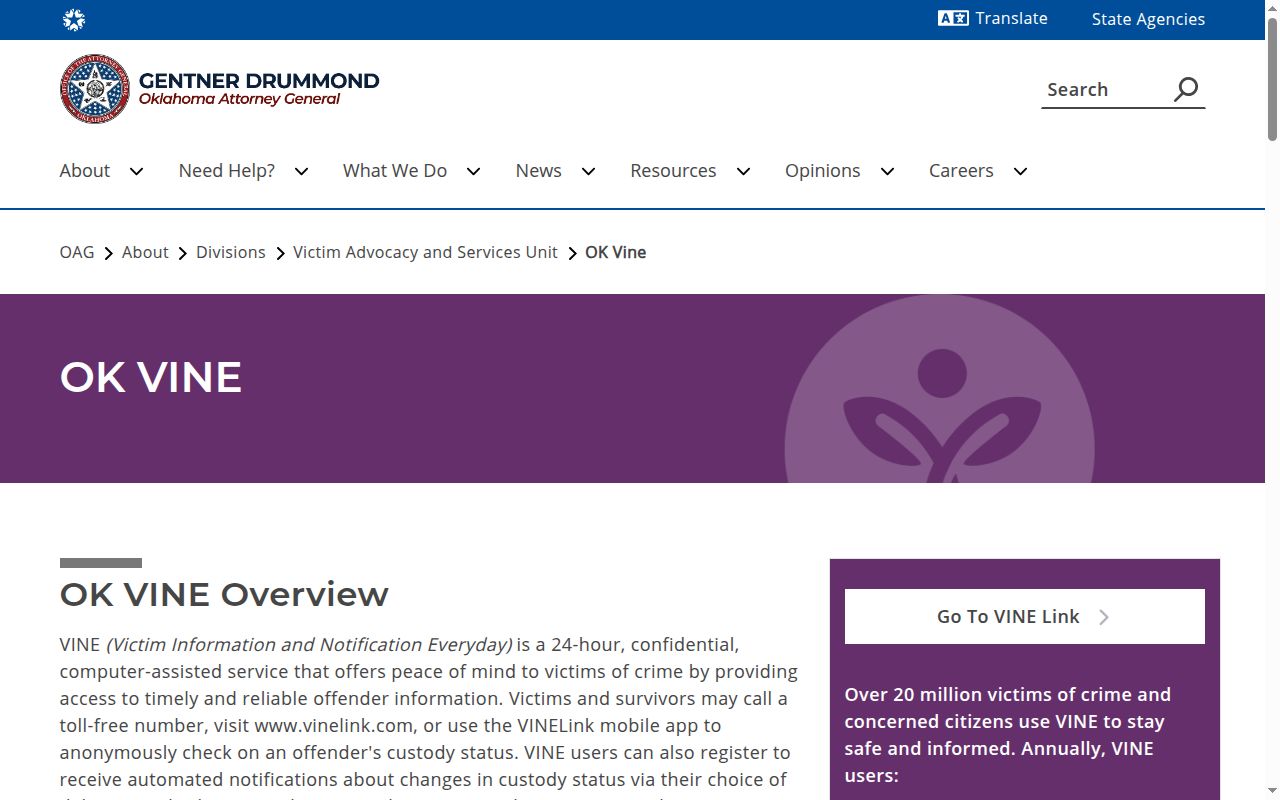
The state guidance establishes the service and its alert channels. A local jail record still supplies the legal reason and destination for a Grant County release.
Search Grant County Releases on VINELink
A one-person search works best with stable identifiers. Start with the full legal name or offender ID. Use age, birth information, agency, or facility when offered to separate similar names. Do not open the first plausible match and assume it is correct.
- Open VINELink and choose Oklahoma before starting the people or offender search.
- Enter the full name or available identifier. Add narrowing details only when needed.
- Compare all matches by agency, facility, age or birth details, and offender identifier.
- Open the exact record and read the custody language, reporting agency, and update time together.
- Save the retrieval date, then verify a reported Grant County release with the Sheriff.
A release or out-of-custody result verifies what the named agency fed into VINE. It does not certify the manner of discharge. A no-result is even narrower. It can arise from spelling, coverage, timing, a recent transfer, or limits on what remains searchable. It cannot be translated into “released.”
If the match points to ODOC, open the official offender lookup and compare the ODOC number, name, birth details, offense information, and photo where displayed. Read status literally. Incarceration is not release. Parole or probation can mean physical placement in the community while a sentence remains active. An inactive, discharged, or history entry must still be interpreted in the context of the actual record. A Grant County detainee who never entered state custody may have no ODOC profile at all.
The Grant County released-inmate search path adds the court, Sheriff record, ODOC, and receiving-agency checks needed when VINELink alone does not resolve the event.
Grant County VINELink Release Fields
The exact display can vary by agency and record. Read only the fields that appear on the matched result. Do not assume a scheduled or exact future release date will be public. ODOC says an inmate’s precise tentative release date is confidential to ordinary public inquirers, and a VINE record should not be used to bypass that limit.
| VINELink item | How to interpret it |
|---|---|
| Name or offender ID | Identity clues that must be checked against the right person |
| Reporting agency | The source custody system for the event |
| Custody status | The agency’s current or reported status wording |
| Facility or location | Where the reporting system places the person, when supplied |
| Event type | Release, transfer, escape, apprehension, death, or another change |
| Update time | When the feed was refreshed, not always the event time |
The source and event fields work as a pair. A Grant County report should lead back to the Sheriff. An ODOC event should lead to the state offender record or Certificate of Release. A transfer should lead to the receiving facility rather than a community-release claim.
Note: A VINE image or status screen documents a retrieval, while an agency release sheet is the stronger durable record.
Register for Grant County Release Alerts
Enrollment should begin from the exact matched record. Oklahoma lists app, telephone, text, email, and TTY notice channels. The choices shown can depend on the interface and event. Enter contact details with care because the notice is tied to the selected person, not merely a name search.
- Open the verified person record and select the available notification option.
- Choose the offered channel, such as phone, text, email, in-app notice, or TTY.
- Enter the destination and review the person and agency before submitting.
- Complete the confirmation displayed by the service. A telephone setup may create a PIN.
- Use the PIN to acknowledge automated calls and stop repeats when the instructions require it.
- Keep the confirmation and update enrollment if the reporting agency or custody path changes.
No fixed PIN length should be assumed. A web, text, or email setup may instead use a code or link. Help and telephone registration are available at 1-877-654-8463. The service operates continuously, but an alert still depends on the agency’s event feed.
Confirm Grant County VINELink Releases
A VINE alert saying “released” starts a verification step. First inspect the agency that sent it. For a Grant County event, call the Sheriff at 580-395-2356 and ask for the date and manner of discharge plus any receiving authority. Follow with a release-sheet request when written proof is needed. If ODOC supplied the alert, inspect the state record and seek the Certificate of Release or sentence-status history where appropriate.
Grant County Jail is at 219 N. First St., Medford, OK 73759. Administrative contact hours are 8:00 a.m.–4:00 p.m. Monday–Friday. These are not guaranteed release times. Contact staff at admin@grantcountysheriff.org or by fax at 580-395-3196 for a focused record request.
Grant County Jail219 N. First St.
Medford, OK 73759
580-395-2356
8:00 a.m.–4:00 p.m. Monday–Friday
For federal sentenced custody, use the official BOP locator. For current immigration detention, use ICE’s locator. Neither system should be used merely because the person once passed through Grant County Jail. The relevant system follows the legal and physical custody chain.
Telephone statements can settle immediate current status, but a written record is better when the event must be preserved. Ask Grant County for the individual release record, not merely whether a name is absent. Include the full name, known booking period, and enough lawful identifying detail to avoid a same-name error. Request the release date and time, manner, authority, and receiving destination if maintained.
Oklahoma Release Notice Layers
Oklahoma divides notice work among separate systems. VINE handles custody change alerts from participating agencies. ODOC Victim Services has distinct victim-notification and record procedures. The Oklahoma Pardon and Parole Board handles hearing and parole notices and expressly states that VINE does not provide parole notification. One VINE registration does not enroll a user in all three layers.
| Layer | Event covered | Key limit |
|---|---|---|
| Oklahoma VINE | Reported custody changes | Depends on the participating agency feed |
| ODOC Victim Services | State corrections victim procedures | Separate from a general VINE enrollment |
| Pardon and Parole Board | Hearings and parole notice | VINE does not provide parole notification |
A transfer from ODOC to an Oklahoma mental-health facility may also deactivate VINE until return. That does not itself mean release. Select the layer that matches the legitimate event of concern and keep agency contact information with the enrollment.
The Board’s VINE boundary guidance explains the separate parole-notice route. It is a key local safeguard when a Grant County search involves a state prisoner rather than a county-jail discharge.
Grant County Release System Boundaries
A custody search fails when it is aimed at the wrong system. Sheriff and court records cover the Grant County jail event. ODOC lookup, records, and supervision channels cover people who entered the state system. BOP covers federal sentenced custody. ICE covers current immigration detention. VINELink can notify across participating agencies but does not merge those records.
- Release
- A reported departure from one agency’s custody. It may lead to the community or another authority.
- Transfer
- A custody handoff to a new jail, prison, federal body, immigration authority, or other agency.
- Parole
- Community release for the remaining part of a state prison sentence under conditions.
- Discharge
- Completion of the sentence or supervision only when the official record uses that status.
If VINE reports Grant County release and the Sheriff names ODOC as destination, the person was not released to the community. If the court shows bond but VINE still shows custody, physical discharge may be pending or another hold may apply. When two records differ, use identifiers, timestamps, and direct agency confirmation before drawing a conclusion.
Agency confirmation should preserve the same distinctions used in the alert. Ask whether the event was a discharge, transfer, escape, or another status change, and ask when it occurred. For a Grant County release, request the jail register or release sheet with the manner and destination. For an ODOC release, a Certificate of Release can record the facility, release day, release category, credits, and remaining supervision. Sensitive forwarding details should not be copied or republished.
Parole and probation are community statuses, not full discharge. Parole means conditional release for the remaining part of a prison term. Probation is court-ordered supervision linked to a suspended or deferred sentence. A VINE custody alert does not replace the ODOC status, court judgment, or supervising-office record needed to understand those conditions.
Note: Never turn a missing VINELink result into a release claim; spelling, scope, transfer, timing, or retention can explain the absence.